FOB Shipping from China: Costs, Risks and Buyer Checklist
FOB shipping can give an importer control over the main sea-freight booking, but an FOB price is not a complete delivered-cost estimate. Before approving a supplier quotation, you need to identify the loading port, the actual cargo handover and the charges outside the purchase price. A container received at a warehouse or terminal also raises an important question: would FCA describe the arrangement more accurately? This guide turns those decisions into a working checklist for buyers sourcing from China. It covers quotation boundaries, booking instructions, document checks and supplier coordination, so you can discuss a defined shipment rather than compare two unexplained totals.

What does FOB mean in shipping?
FOB means Free On Board. Under the Incoterms® 2020 rule, the seller delivers on board the vessel nominated by the buyer at the named port of shipment. That is the ordinary delivery and risk-transfer point. The seller handles export clearance; the buyer normally arranges the main carriage and import formalities. The rule is intended for sea and inland-waterway transport. See the ICC’s official FOB rule for the obligations and exceptions.
A purchase order should identify the rule, port and edition together, for example, FOB [agreed port of shipment], Incoterms® 2020. Replace the bracketed wording with the actual agreed port; a supplier’s office address or the buyer’s destination city is not an adequate substitute.
Keep the sales agreement separate from the freight booking
When asking what FOB means in shipping, distinguish the supplier’s sale from the carrier’s transport contract. The former allocates responsibilities between buyer and seller; the latter sets the booked transport service. Your purchase order, freight quotation and booking confirmation should tell a consistent operational story.
FOB does not, by itself, settle payment deadlines, transfer of ownership or every document needed in the importing country. The International Trade Administration’s Incoterms overview explains these limits. Specify those matters separately, and obtain professional advice where the contract or destination requirements are uncertain.
Who pays the FOB shipping costs?
Use the table below as a starting point for a charge-allocation discussion, not as a substitute for the agreed contract. Ask the supplier and forwarder to reconcile any local charge that appears in both quotations.
| Stage | Usual FOB allocation | Buyer’s check |
|---|---|---|
| Delivery through loading on board | Seller, subject to the rule and agreed variations | Identify the loading port and included origin work. |
| Export formalities | Seller | Confirm the exporting party and required information. |
| Main ocean carriage | Buyer | Check the booked route, surcharges and validity. |
| Import clearance and duties | Buyer | Confirm the importer and destination arrangements. |
| Cargo insurance | Not automatically included by FOB | Arrange and verify any required cover separately. |
An invoice’s billing address does not necessarily settle who ultimately bears a cost under the sale. If an agent collects a terminal or documentation charge from you, ask whether it is already covered by the supplier’s agreed scope before treating it as an additional buyer cost.
Build a comparable total
Your budgeting worksheet should keep the goods price, international freight, destination handling, import costs and onward transport in separate lines. Mark unknown items as unconfirmed rather than entering zero. Retain the currency, charging unit and validity date beside each figure.
Compare alternative ocean freight from China quotations against the same cargo details. A lower freight line cannot establish the lower total if one offer excludes destination handling or uses a different receiving point. Request a shipment-specific quotation instead of relying on a generic FOB shipping rate.
When should FCA replace FOB for containers?
Start with a practical question: where does the seller actually hand the cargo to the carrier? Many container moves involve receipt at an inland location, container freight station or port terminal before vessel loading. Describing that event accurately matters more than retaining a familiar three-letter abbreviation.
The ICC Academy’s FCA-versus-FOB explanation recommends considering FCA for containerized and multimodal movements. FCA can name a defined carrier handover location, while FOB delivery is tied to loading on the vessel. The exact FCA delivery conditions depend on the named place; do not assume every warehouse handover has identical loading or unloading responsibilities.
If your supplier says “FOB warehouse,” pause and clarify the intended arrangement. Record the warehouse address, who loads the collecting vehicle, who books carriage, and when responsibility is intended to change. Then have buyer and seller agree the suitable term and wording before collection.
Apply the same check to LCL
With less-than-container-load cargo, cartons may enter a consolidation facility well before a container reaches the ship. Ask whether FCA at the agreed receiving point better reflects that handover. This is not a reason to rename the transaction unilaterally: the supplier, buyer and logistics instructions must agree.
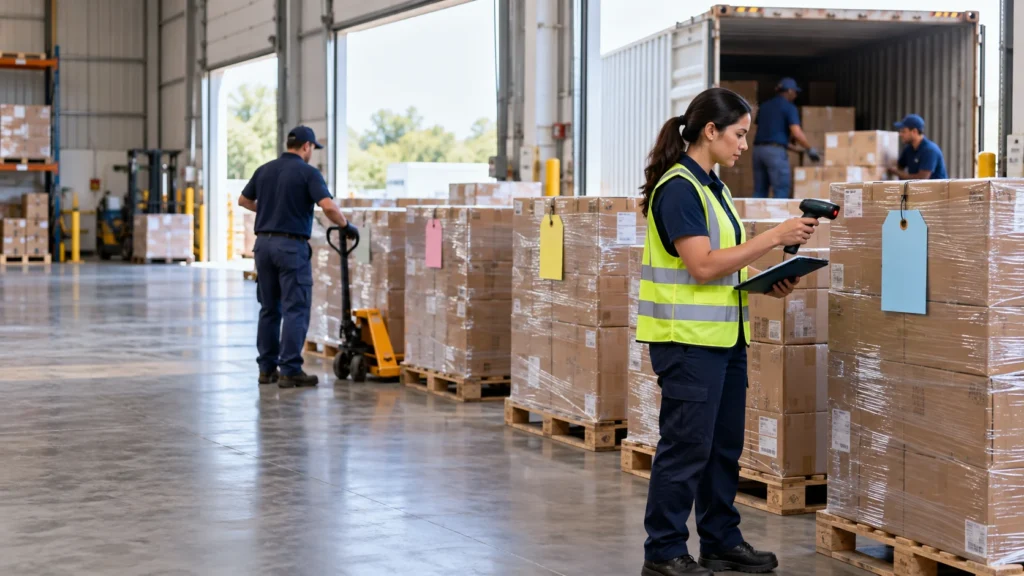
Photographs of cartons entering a warehouse are useful receiving evidence, but they are not evidence that FOB delivery on board has occurred. Keep the receiving record and the vessel-loading evidence as different milestones in your shipment file.

How to compare FOB quotations without missing charges
A useful quotation comparison begins with a common brief. Give every party the same product description, package count, packed dimensions, gross weight, cargo-ready date, origin location and destination. Identify whether the request concerns a full container or consolidated cargo, and flag anything that could affect acceptance or handling.
Ask for a written scope reconciliation
- Which supplier-to-port activities are included in the goods price?
- Which origin charges will the nominated forwarder invoice, and to whom?
- What destination handling and release charges are included or excluded?
- What does the onward transport scope include, if requested?
- Which costs are conditional, and what event triggers them?
- How long is the offer valid, and what changes require a revised quotation?
A label such as “local charges included” is difficult to audit. Request named items or a clearly defined boundary. If two providers use different descriptions for the same work, ask them to explain the difference rather than adding both amounts automatically.
Keep service differences visible. A quotation to one discharge port is not directly comparable with another discharge port merely because both serve the same country. Likewise, a port-only estimate and a warehouse-delivery estimate have different endpoints.
For the broader distinction between seller-paid freight and the point where risk changes hands, use our FOB, CIF and CFR comparison. Record any negotiated departure from the standard rule explicitly in the sale agreement; do not leave it buried in an informal chat message.
What should a buyer confirm before the freight booking?
Prepare one instruction sheet with a version date and a named contact for each decision. Send the same approved version to the supplier and forwarder. A short, complete brief is easier to act on than several messages containing conflicting weights or dates.
Minimum booking brief
- Goods: commercial product description, materials or technical details needed for review, package type and any handling restrictions.
- Measurements: final carton or crate count, external dimensions and gross weight; identify estimates clearly.
- Origin: supplier contact, collection or handover address, agreed port and cargo-ready date.
- Destination: discharge point, consignee, importer contact and any requested final transport scope.
- Authority: who approves booking changes, extra work and release instructions.
Then work backward from the proposed sailing. Ask the forwarder to identify the applicable cargo, document and other booking cutoffs. Ask the supplier whether production, packing and export preparation can meet them. A factory’s estimated completion date is not the same as confirmed shipping readiness.
Do not nominate a vessel or send delivery instructions that the supplier has not received and acknowledged. Request a clear escalation path if the date or receiving location changes. Late information can require revised arrangements even when the goods themselves are ready.
If you are still gathering the basic cargo information, use the freight quotation checklist before asking for a final booking. Keep assumptions separate from confirmed instructions so the provider can identify what still needs verification.
Which documents and release checks matter?
Create a document checklist for the actual goods and destination instead of assuming that one generic pack suits every shipment. Ask the destination broker or appropriate adviser to confirm what is required before the supplier finalizes the documents.
At minimum, coordinate the commercial invoice, packing information and transport-document instructions. Check the legal names, addresses, product descriptions, quantities, package count and measurements against the booking and purchase order. Do not quietly change product descriptions simply to make a document appear easier to clear.
Approve drafts before issue
Ask who will prepare the bill of lading instructions and who may approve the draft. Confirm the intended shipper, consignee and notify party, along with the ports and cargo particulars. Resolve discrepancies while they are still drafts rather than waiting until the shipment is moving.
The transport-document and release process should also match the commercial payment arrangement. Confirm who can authorize any requested release method with the carrier or forwarder. Do not treat a screenshot, a freight payment or an FOB label as sufficient proof that every party has authorized cargo release.
Store the approved documents, changes and handover evidence together. If the final loaded quantities differ from the order, record the difference and the agreed document correction instead of leaving contradictory versions in circulation.
Our first-time import documentation guide offers a starting workflow. It does not replace a product-specific customs review. Restricted goods, regulated products and destination certification questions need separate confirmation before dispatch.
How to coordinate FOB orders from multiple suppliers
Do not assume that several supplier quotations marked FOB can be combined without changing the operating plan. The suppliers may name different ports, have different ready dates or expect delivery through different agents. Establish a shipment map before choosing a common sailing.
Create a line for each purchase order showing the supplier, agreed trade term, named place or port, package count, ready date and handover contact. Mark which supplier scope ends where. This exposes extra inland transport or receiving work that a single total can hide.
Agree the consolidation point first
If you want the cargo combined at a warehouse, ask how that new receiving point fits each sale agreement. Moving a supplier’s handover from vessel loading to an inland warehouse can require a revised term or expressly agreed responsibilities. Obtain the supplier’s written agreement before issuing revised shipping instructions.
For cargo consolidation in China, define receiving checks, identification labels, storage decisions and any repacking authorization. Tell the warehouse how to distinguish orders and who may approve work when packing is damaged or quantities differ.
Decide what happens if one supplier misses the agreed date. The options might include waiting, splitting the shipment or revising the booking, but each needs a cost and timing review. Do not promise a combined departure until the responsible parties have checked the actual cargo and booking status.
Keep purchase-order follow-up separate from transport confirmation: a supplier saying “finished” should trigger readiness verification, not an automatic assumption that cargo has been received, cleared or loaded.
How to manage insurance, delays and exceptions
Risk allocation does not make damage impossible, and a freight booking is not the same as cargo insurance. Discuss insurance separately with a qualified provider, using the actual goods, value, packaging, route and handover plan. Ask when cover begins and ends, what is excluded, and what evidence is required for a claim.
Consider the stages before and after the agreed risk-transfer point. If different parties arrange cover for different stages, check for a gap at the handover. Do not assume that carrier liability provides the same protection as a cargo insurance policy.
Give exceptions an owner
A workable shipment plan identifies who receives a damage report, who authorizes a survey or inspection, and who can approve storage or revised transport. Record the provider’s notification requirements and keep photographs, delivery records and communications if a discrepancy occurs.
For delays, ask which event created the additional work and which contract governs the resulting charge. Port storage, container use and exceptional handling should not be collapsed into an unexplained “FOB extra.” Request the applicable basis and supporting details before approving an invoice.
The ordinary FOB handover summary is not an exhaustive account of every risk scenario. Buyer-notice failures or a nominated vessel failing to take cargo can raise exceptions under the rule. Review the applicable contract and rule with an appropriate adviser instead of relying on a simplified online definition to decide a dispute.
Keep schedules conditional on confirmed arrangements. A quotation, a proposed sailing and an estimated arrival are different records; none should be presented internally as a guaranteed delivery commitment unless the relevant provider has actually agreed that commitment.
A practical FOB buying scenario and final checklist
The following is an illustrative planning scenario, not a reported VG Shipping customer case. A buyer has an FOB offer for machinery parts from one supplier and wants a second supplier’s spare parts included in the same shipment. The first offer names a port; the second only says “FOB China.” Neither statement confirms that warehouse consolidation has been agreed.
The buyer first asks the second supplier to identify its intended delivery point and scope. Next, the forwarder reviews the proposed receiving location and cargo details. The parties then check whether FCA at a named location would better match any pre-vessel handover. Only after those boundaries are agreed can the buyer compare a combined plan with separate shipments.
Before approving the shipment
- Write the rule, named port or place and Incoterms edition into the purchase agreement.
- Confirm the real physical handover; check FCA where containers are received before vessel loading.
- Reconcile the supplier and forwarder’s origin charges, with no unexplained duplication.
- Obtain final packing data and flag any cargo acceptance questions.
- Align ready dates, receiving instructions, booking cutoffs and approval contacts.
- Confirm destination responsibilities, documents, release instructions and insurance arrangements.
- Record excluded or conditional costs and the trigger for a revised quotation.
The objective is not to make FOB the answer to every purchase. It is to choose wording that fits the movement and to give every participant instructions they can follow. A well-defined FCA arrangement is more useful than an ambiguous FOB label, just as a properly specified FOB purchase can work when vessel loading is the intended delivery point.
Related sourcing support
 Purchase Order Follow-Up
Purchase order follow-up in China for supplier updates, specification changes, sample approvals, production readiness and cargo handover coordination.
View the product ↗
 Multi-Supplier Consolidation
Multi-supplier consolidation in China for receiving lists, supplier cargo records, sorting, repacking coordination and a defined combined-shipment handover.
View the product ↗
 Sourcing-to-Delivery Solution
A sourcing-to-delivery solution from China connecting product briefs, supplier follow-up, sample approvals, consolidation and international freight preparation.
View the product ↗
Related shipping solutions
 Importers & Wholesalers
Connect supplier readiness, multi-supplier consolidation and freight around wholesale orders and replenishment plans.
Explore solutions ↗
 Manufacturers & Trading Companies
Plan collection and transport around production milestones, export orders and customer delivery requirements.
Explore solutions ↗
 SMEs & First-Time Importers
Prepare a clearer cargo brief and compare transport and delivery choices before a first or smaller business shipment.
Explore solutions ↗
FOB shipping FAQs
What does an FOB supplier quotation include?
An FOB quotation should identify the named port of shipment and the seller’s scope through delivery on board under the agreed rule. Ask for the origin activities and charges to be made explicit. It is not a complete destination-cost estimate: reconcile the separate freight quotation, import responsibilities and any onward transport before approving the purchase.
Who pays ocean freight when buying FOB from China?
The buyer normally arranges and pays for the main ocean carriage under FOB. Confirm who makes the booking, how the seller receives vessel and delivery instructions, and which charges each quotation covers. If the seller is arranging transport on the buyer’s behalf, document that arrangement rather than assuming it changes the agreed trade term.
Does an FOB price include cargo insurance?
FOB does not automatically include a seller-provided cargo insurance policy. If cover is required, arrange it separately and verify the insured goods, value, route, period, exclusions and claims procedure with the provider. A freight booking or carrier liability should not be treated as confirmation that a suitable cargo policy is in place.
Is FOB appropriate for an LCL shipment?
Review the actual handover first. LCL goods often enter a consolidation facility before vessel loading, so FCA at an agreed receiving point may describe delivery more accurately. Buyer and seller should agree the term, named location and handling responsibilities before collection; the forwarder should not silently rewrite the sales agreement.
What should I check before accepting an FOB quotation?
Confirm the named loading port, rule edition, cargo details, readiness date and the origin charges included in the purchase price. Compare the separate freight and destination scope on the same basis. Also agree booking instructions, document approvals, release authority and insurance arrangements, and resolve any difference between the stated term and the physical handover.
Conclusion: agree the handover before booking
FOB shipping from China works best when the sales term, cargo handover and freight instructions describe the same arrangement. Identify the named port, reconcile origin charges and keep destination costs visible. For containers handed to a carrier before vessel loading, discuss whether FCA is the more suitable choice.
To review a proposed shipment with VG Shipping, share the supplier’s quotation, agreed trade term, cargo description, packing data, ready date and destination. Request a shipment-specific freight review so the route, service boundaries and outstanding information can be checked before booking.
This article provides general shipment-planning information, not legal, customs or insurance advice. Contract wording and product- or country-specific requirements need appropriate professional review. Illustrations are AI-generated and do not depict an actual VG Shipping shipment.
Related shipping guides from our blog
How to prepare documentation for first-time imports from China
A first import becomes easier to coordinate when everyone works from the same cargo description, shipment quantities and…
↗
A simple checklist before requesting a freight quote
Prepare a China freight quote with pickup and delivery addresses, packed dimensions, gross weight and cargo ready date.…
↗
Connecting supplier orders with warehouse handovers
Coordinate supplier pickup and China warehouse receiving with consistent packing lists and release instructions. Track purchase orders through…
↗